Showing posts with label chicken. Show all posts

Thursday, 22 May 2014

Soy chicken thighs and egg fried rice


Soy chicken and egg fried rice
Another recipe based on one from Nigel Slater, again from his book Eat.

I've yet to find the recipe online but when I do I'll include a link. In the meantime, here is my version.

Soy chicken thigh ingredients


  • About 150ml oyster sauce
  • 2 tablespoons soy sauce
  • 2 garlic cloves, crushed
  • 1/2 teaspoon crushed dried chillies
  • 1 tablespoon palm sugar
  • 4 chicken thighs


How to make soy chicken thighs

  1. Heat the oven to 200 degrees C
  2. Mix all the ingredients except the chicken together in a shallow, ovenproof dish.
  3. Add the chicken thighs and toss to coat.
  4. Put in the oven for about 40 minutes, basting every 10 minutes or so. 

In the meantime, make the egg fried rice.
You need to use rice that has already been cooked and then cooled for egg fried rice, otherwise it will be soggy. I normally make double the quantity of rice for dinner the day before, then immediately cool the rice I don't use by running under a cold tap and leaving to drain, before storing in a tupperware container in the fridge till the next day.

As a rule, measure out dry rice by volume, not weight - about 75g per person will give you a greedy person's amount. 

Egg fried rice ingredients (enough for 2)


  • 2 portions long-grain or Basmati rice
  • 2 eggs, lightly beaten in a jug.
  • 1 medium onion, finely chopped
  • 2 rashers smoked back bacon, or 3 rashers smoked streaky bacon, cut into small pieces
  • A large handful frozen peas
  • 3 spring onions, finely chopped
  • Soy sauce, to colour and taste

How to make egg fried rice

  1. Heat some groundnut or other flavourless oil in a wok.
  2. When it is very hot, add the chopped onion and cook till it starts to brown.
  3. Add the chopped bacon and cook, tossing it around the wok.
  4. Add the cooked rice and toss to coat with the oil and mix with the onion and bacon.
  5. Once the rice has heated through, add the eggs to the pan with the spring onions.
  6. Leave unstirred for about 10 seconds, then stir the eggs around with the other ingredients in the wok to coat.
  7. Once the egg has cooked, remove from the heat.
  8. Add a splash of soy sauce and stir again, so that all the rice turns brown.*

*For this recipe I didn't add any soy sauce as there was plenty of cooking sauce from the chicken which I used insterad.


Friday, 31 January 2014

Keith Floyd's garlic chicken

My sister-in-law showed me this recipe when I last saw her on New Year's Eve. I have to admit I didn't pay that much attention to it at the time (I was watching Julie and Julia), so when O suggested I make it, it took a bit of online searching to find it. Eventually I came across it on this cycling forum:

http://www.cyclechat.net/threads/pot-roast-chicken-with-100-cloves-of-garlic.86254/

It is an incredibly blokey recipe, I admit. I could not Cope with the amount of Capital Letters used in the Recipe and had to Correct them in my version below, which also includes little more detail than the bike shop boys give. The cycling forum version also suggests that wind (or, as they call it, Wind) might be a consequence of eating this recipe. I don't think you are actually supposed to eat all the garlic that you cook - in fact I think we stopped at 1 or 2 cloves. 

The cycling forum also suggests the chicken is served with tagliatelle and a balsamic-dressed salad. I served this with rice, and forgot to take a photo. Unfortunately, I don't think there will be a next time. 


Ingredients for Keith Floyd's garlic chicken


  • 1 large chicken
  • 12 bulbs* garlic
  • 250 ml red wine vinegar
  • I bunch fresh thyme

*Yes, bulbs.

How to make Keith Floyd's garlic chicken


Heat the oven to 180 degrees C
Break up the garlic bulbs into unpeeled cloves, keeping 2 bulb's worth of cloves separate from the rest.
Place these 2 bulb's worth of garlic inside the cavity of the chicken along with the thyme.
Season the chicken with salt and pepper, then rub all over with olive oil.
Place the remaining garlic in a large casserole dish for which you have a lid.
Put the chicken on top of the garlic.

Pour in the red wine vinegar.
Cover the pot with the lid and place in the oven for 60-75 mins.

Take the lid off and cook for another 30 to 40 mins - if it looks like it is drying out, add a little water.
 

Tuesday, 7 January 2014

Chicken noodle soup


Not leftover roast chicken risotto

I'm so bored with being told that you can make a roast chicken last 3 days by making risotto with some of the leftover chicken and homemade stock. For me, risotto is monotonous stodge on a plate.

Go for something light like this healthy soup instead. You'll still have plenty stock left to freeze or use for thick chicken soup, and leftover cold roast chicken is a fine addition to any salad. 

Chicken noodle soup ingredients


  • 2 bowls homemade chicken stock
  • A handful mange tout
  • A handful kale leaves, roughly chopped
  • 4 spring onions, diagonally sliced
  • A splash dark soy sauce
  • A tiny splash nam pla
  • 1 bruised blade  lemongrass
  • 1/2 lime
  • 1/2 teaspoon chilli paste
  • I nest dried thin noodles
  • As much leftover roast chicken as you want to add

How to make chicken noodle soup


  1. Bring the chicken stock to a rolling boil in a medium-sized pan.
  2. Add the splashes of nam pla and dark soy sauce, together with the bruised lemongrass stalk and chilli paste.
  3. Add the noodles then after 1 minute drop in the vegetables and the cooked chicken. 
  4. Simmer for a minute or 2, until the chicken is warmed but the vegetables remain crunchy.
  5. Remove from the heat and ladle into individual bowls, then squeeze 1/4 lime into each bowl.

Thick chicken soup

For this soup I used the leftovers and stock from New Year's Eve's roast chicken with tarragon, so if you don't have any tarragon wilting in your fridge you can do without. 

  Thick chicken soup ingredients

  • About 700ml homemade chicken stock
  • 1 large leek
  • 1 large banana shallot
  • About 200ml milk
  • 2 tablespoons crème fraîche
  • 1 handful cooked chicken per person
  • About 3 sprigs tarragon
  • 1 medium potato

How to make thick chicken soup

  1. Heat a little rapeseed oil in a large pan.
  2. Finely chop the shallot and leek, add to the pan and sweat gently till soft.
  3. Add the stock to the pan.
  4. Peel the potato, chop into small cubes and add to the pan.
  5. Bring to the boil then simmer gently for about 20 minutes.
  6. Chop the tarragon very finely and add to the soup along with the milk and crème fraîche.
  7. Simmer for another 10 minutes - the potato should have collapsed completely and the soup thickened. If the soup is not as thick as you'd like, turn the heat up a little and continue to cook till it reduces and thickens.
  8. Add the cooked chicken, torn into pieces, just before you want to serve the soup to warm through. 
If you've made a big batch of soup to freeze or have later and only want a portion or two now, heat just enough soup and chicken as you need in a separate pan - if you heat then reheat the chicken it will get tough and taste awful. 

Saturday, 31 August 2013

Asian-poached chicken salad

Chicken noodle salad

 
Feeling utterly uninspired last night I decided to poach a whole chicken with Asian flavours. 

I had no idea how it was going to taste as the recipe was loosely based on several I found online, what sounded right to me and what I had in the fridge.  

Asian-poached chicken ingredients

  • 1 large free range chicken
  • 2 sticks celery, cut into batons
  • 1 large carrot, cut into thick slices
  • 2 spring onions, cut into long sticks
  • 1 onion, peeled and cut into quarters
  • 2 star anise
  • 1 tablespoon black peppercorns
  • I large piece root ginger, peeled and cut into rough chunks
  • 5 tablespoons soy sauce
  • 3 fat (or 5 normal) garlic cloves, crushed but not peeled
  • 1 lime, halved
  • 5 tablespoons Shaoxing rice wine


Method for making Asian-poached chicken


Poaching a chicken


  1. Add all the ingredients to a stock pot
  2. Cover with water 
  3. Bring to the boil for 20 minutes
  4. Reduce to a simmer and continue to cook for 40 minutes
A couple of recipes I found online gave instructions to switch off the heat after the 20 minutes boiling and leave the chicken in the poaching liquor for 3 hours. However this would have meant eating at about 10.30pm so I simmered it for 40 minutes instead.

After 40 minutes I switched off the heat and left the chicken to cool slightly in the poaching liquor for about half an hour.

Chicken and vegetable noodle salad


I pulled some of the meat from the poached chicken to add to a noodle salad. 

Chicken noodle salad ingredients


Meat pulled off the chicken

  • 5cm carrot
  • 5cm courgette
  • 5cm cucumber
  • 2 spring onions
  • 1/2 red pepper
  • A couple of slices of a small red cabbage
  • 2 nests noodles (I used medium egg noodles, but feel free to use whatever type you have)
  • 1 tablespoon toasted sesame seeds 
  • A handful mint leaves
  • A handful coriander leaves
  • As much chicken as you want to eat, torn into strips
  • Chopped red chilli, to serve

Chicken noodle salad dressing ingredients


  • 3 tablespoons sesame oil
  • Juice of a lime
  • 2 tablespoons peanut relish
  • 1 teaspoon fish sauce

How to make the chicken noodle salad 

  1. Combine the dressing ingredients in a screw-top jar and shake vigorously.
  2. Cut all the vegetables into long strips.
  3. Chop the mint and coriander finely.
  4. Cook the noodles per the instructions and rinse under a cold tap.
  5. Tip the noodles into a large serving bowl and pour over the dressing.
  6. Add the herbs, vegetable and chicken strips and toss to coat with the dressing.
  7. Sprinkle over the sesame seeds.  
  8. Serve with the chopped chilli on the side for people to add as much as they like. 
Although this salad was good, it did lack a little oomph. I'd used the last of my root ginger poaching the chicken, but think a teaspoon or so would have been a welcome addition to the dressing. Personally, I would have added the chilli to the dressing too, but put this on the side because I was cooking for someone with a very low heat threshold. 


Chicken stock for soup


Today I made chicken stock to use in chicken or noodle soups.

  1. Heat the oven to 1800C.
  2. Strip the remaining meat from the carcass.
  3. Strain the poaching liquid through a sieve then return to the stock pot.
  4. Put the bones and carcass in a roasting tin and roast for 25 minutes.
  5. Add the bones to the strained liquid.
  6. Bring everything to the boil.
  7. Reduce the heat to a simmer and continue simmering for 1 hour.
  8. Strain the liquid through a sieve again. 


Friday, 22 March 2013

Accidentally amazing soup

I didn't think this soup would taste so good! I originally intended to add miso paste, but having warmed and tasted the stock I decided not to. I then thought about adding some nam pla, but after adding the lemongrass and allowing it to infuse, the sweet, almost sickly taste of the stock was transformed into a lighter, fragrant broth. The chopped mint scattered on top just accentuated the fresh taste. 

Of course, there's no guarantee your soup will turn out this good every time. The key is in the stock. In this instance, I had an aniseedy stock made from the bones and cooking liquor from a duck dish I made for friends a few weeks ago. If I'd used chicken stock, I probably would have added that nam pla, and maybe a bit of soy sauce. A vegetable stock version would most definitely have needed that miso paste.

Chicken noodle soup ingredients


  • Duck stock
  • 4 chicken thighs
  • 3 lemongrass stalks
  • 1 red chilli
  • 2 large handfuls spinach
  • 2 portions sugarsnap peas
  • 2 servings soba noodles
  • 1 sprig mint

2 warmed bowls

How to make chicken noodle soup 

  1. Add some rapeseed oil to a frying pan and heat till hot.
  2. Add the chicken thighs to the pan, turn down the heat, and brown. Turn and brown the other side.
  3. WARNING: THERE WILL BE SMOKE AND SPLUTTERING HOT FAT.
  4. Meanwhile, put the stock in a solid-based, high sided pan, and warm.
  5. Add the browned chicken thighs to the warm stock and bring to a lively simmer.
  6. Finely chop the chilli and add to the stock.
  7. Bash the lemongrass with a pestle and snap into pieces so that you can fit it in the pan. 
  8. Cook for about 20 minutes.
  9. After about 15 minutes, boil a kettle of water, tip into a separate pan and cook the noodles for about 5 minutes.
  10. Add the spinach and sugarsnap peas to the stick mixture and cook fora further 3 minutes. 
  11. Drain the noodles and add to the warmed bowls.
  12. Ladle over the broth with the vegetables and chicken thighs. 
  13. Scatter over the chopped mint and eat straight away.

Sunday, 10 February 2013

Sweet chilli chicken salad

Some people and a bit of salad
This is a delightfully fresh-tasting salad. Grateful thanks to chef extraordinaire, Miss Kate "K-Dog" Turner for the recipe.

Serves 10.

Chilli chicken salad ingredients

  • I large bag rice noodles
  • 2 whole cooked chickens*
  • 3 red peppers
  • 1 bunch spring onions
  • 2 carrots
  • 1 cucumber
  • 2 mangoes
  • 3 avocados
  • I bag mange tout (snow peas)
  • I bunch coriander (cilantro)
  • Peanuts - about 4 handfuls (I have small hands. Maybe 3 handfuls if you have man-hands)
  • A large quantity sweet chilli dressing
*Preferably, buy and cook your own chickens. As in, buy dead chickens then cook them. Though if you want to buy live chickens, spend time raising them, then slaughter and cook them, I take my hat off to you.
Instinct tells me the £4.49 ready-cooked chickens from Tesco probably didn't have a happy a life. If you didn't like the Henry Pig salad photo, consider becoming vegetarian. Personally, I prefer to know that my lunch lived a happy life before it was slaughtered so mI could eat it.

Sweet chilli dressing ingredients 

  • Juice of 1 lemon
  • White wine vinegar, or preferably, rice wine vinegar - about the same quantty as the lemon juice
  • Sugar, or, preferably, palm sugar (1/4 cup), dissolved in the same quantity boiling water
  • I dried chili, de-seeded (keep the seeds)
  • Coriander powder
  • 3 tablespoons fish sauce
  • 4 crushed garlic cloves

How to make sweet chilli dressing

  1. In a small pan, mix together the lemon juice, vinegar, sugar in water, powdered coriander, fish sauce and garlic cloves.
  2. Simmer gently for about 5 minutes, till it starts to thicken.
  3. Add the crumbled dried chill along with the seeds.
  4. Garnish with fresh coriander leaves. 

How to make chilli chicken salad

  1. Cook the rice noodles in some light chicken stock for about 5 minutes.
  2. Drain and refresh under cold water.
  3. Immediately toss in 1 teaspoon sesame oil, or, if you have some to hand, some sesame-based dressing.
  4. Toast raw peanuts lightly in a pan then crush. 
  5. Slice the peppers into long, very thin strips
  6. Slice the spring onions diagonally into short strips.
  7. Cut the carrots and cucumbers into julienne strips.
  8. Cut the mango and avocado into thin strips.
  9. Chop the coriander.

Lay everything out on separate plates and let people help themselves.**

**For salad club only. At home, mix everything together with the noodles and top with the toasted crushed nuts. 

Sunday, 16 September 2012

Salad Club III: Who is him? Greek salad

Today's salad is in honour of our former Greek colleague. We miss you, Nikki Papadaki.

Authentic Greek salad does not contain lettuce or chicken. For some reason, our version included cooked chicken, but I did draw the line at lettuce.


Greek salad ingredients

  • 2 packs feta cheese (400g in total)
  • 1 large cucumber, cut into cubes
  • black olives, a large tub
  • 1  red and 1 yellow pepper, cut into cubes
  • 2 punnets cherry tomatoes
  • 1 small red onion, very finely sliced
  • 1bunch mint
  • 1 bunch basil
  • Cooked chicken


Greek salad dressing ingredients

  • Olive oil
  • Lemon juice
  • Thyme
  • Salt & pepper
 

Greek salad accompaniments to serve

Hummus, tzatziki, pitta bread. 


This week's salad club got a little out of hand. There were too many members (9) and too many slackers. We almost ran out of food and I had to send out rules. 

This week's star Tosser was Amber, who brought in home made tzatziki. Kate also deserves a special commendation for the salad dressing.


Salad Club II: Mexican chicken

Mexican chicken salad ingredients


  • 1 whole cooked chicken 
  • 2 ripe avocados 
  • 1 punnet cherry tomatoes
  •  2 Cos lettuces, or 1 Romaine lettuce (any crispy lettuce will do) 
  • 1 small red onion 
  • 1 tin sweetcorn 
  • 1 tin kidney beans 
  • Coriander (cilantro, I am bilingual), chopped (optional) 
  • 1 quantity salsa dressing

    How to make Mexican chicken salad


    This is the easiest salad to make in the world, since we bought a cooked whole chicken from the supermarket. 

    1. Pull the chicken meat off the carcass
    2. Chop the tomatoes in half
    3. Cut the cucumber into thick slices, then quarter the slices
    4. Finely chop the onion
    5. Slice the avocado into thin slices
    6. Put everything in separate bows
    7. Empty the sweetcorn into its own bowl, and the beans into another
    8. Get Courtney to make the salad dressing.

      Enjoy!

      Sunday, 9 September 2012

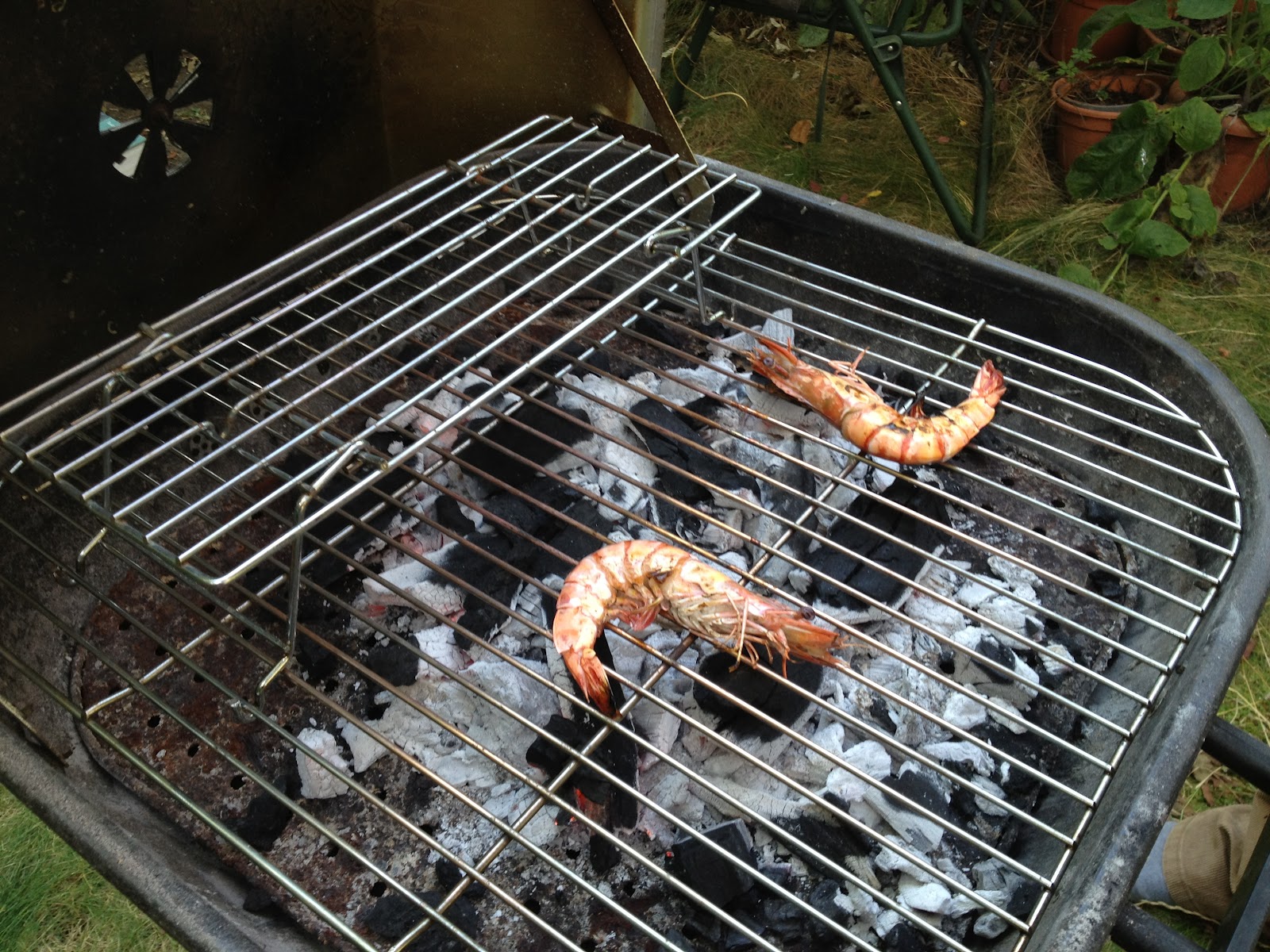
      Prawns, sardines and chicken on the barbeque

      Halfway through September, and summer finally arrived. I  wished I hadn't left the barbeque exposed to the elements for a year, it would have saved my nails from splitting cleaning it with wire wool.


      To start, large shell on prawns, marinaded in crushed garlic and lemon juice. Delish.

      Next, sardine fillets that the fishmonger somehow convinced me to buy. These were marinaded in olive oil, dill and lemon juice.These only took a few minutes each side  to cook on the barbie.


      To go with this, a potato salad, based on several of Nigel Slater's recipes.  

      Potato salad ingredients

      • 1/3 cucumber
      • 6 cornichon
      • baby new potatoes - about 300g
      • 1/2 bunch dill
      • 1/2 bunch chives
      • 2 tablespoons half fat creme fraiche
      • 1 teaspoon Dijon mustard  
      • I tablespoon extra virgin olive oil
      • I teaspoon cider vinegar 

      How to make potato salad


      You need to prepare the cucumber by halving then quartering it and then cutting out the slimy jelly seedy bit in the middle or else it will make your potato salad go soggy. Its not really the best bit of the cucumber in any case. 

      Mix together all the ingredients apart from the potatoes in a large shallow dish.

      Then you just need to cook the new potatoes by putting them in a pan, pouring over some boiling water and adding a good pinch of salt. Turn down to a simmer then cook till tender - probably about 20 mins depending on the size and variety of the potatoes.

      Once the potatoes are tender when tested with a skewer, drain and then toss in the dressing straight away while still hot. This allows the flavours to be absorbed and prevents your potatoes from drying out.

      By the way, don't ever add boiling water to floury potatoes (they type you would use for mash or roasties) as they will fall apart in the water.

      As you can see, we also had a cheeky little corn on the cob with our sardines and potato salad.


      Finally, chicken kebabs. 

      Chicken breasts were cut into largeish pieces and marinaded in olive oil, thyme leaves, lemon juice and garlic for a couple of hours. 

      I then threaded them onto wooden skewers, soaked for a few minutes in boiling water so the chicken doesn't stick to them, interspersed with pieces of red onion, yellow peppers and cherry tomatoes.

      This threading of different vegetables and the meat turned out to be a mistake: the tomatoes were cooked within minutes and started to drip off the skewers. After a little reassembly job the chicken and peppers cooked at the same time, with the onions taking a little longer. This didn't matter, as it gave the chicken a few minutes to rest while the onions finished cooking.


      Friday, 27 July 2012

      Hummus and pesto – tastes of summer

       
      Two things I never buy are hummus and pesto. Why? Because supermarket hummus is a slushy gloop and pesto in a jar tastes of watery chemicals. Admittedly the stuff you buy in delis is usually good, but also expensive. Homemade versions outshine every time, and are so easy and cheap to make. Making your own also means you can adapt the flavours to suit your own tastes. 


      It’s difficult to give exact measurements for these recipes – you will need to tinker to get the flavour and texture you want. The added bonus is that the dish will be unique each time you make it.

      Give it a go – really, the hardest part is washing up the food processor. 

      Hummus ingredients


      • 1 can chickpeas, or equivalent cooked chickpeas.
      • 1 small clove garlic, finely chopped. One of the cloves you find in the centre of a bulb is about the right size.
      • 1 tablespoon tahini paste. There really is no need to explain what tahini is these days. If you can buy it in Sains, no need to explain.
      • Juice of half a lemon.
      • Olive or rapeseed oil and a little water, enough to make the hummus the consistency you like.
      • Pinch paprika (optional).

      A note on oil

      What oil you use will greatly affect the flavour of your hummus. I like a subtle little kick to my hummus and so add a tiny amount of chilli oil (homemade of course) to the Spanish extra virgin olive oil I normally use.

      This time, though, I used my new favourite ingredient – rapeseed oil. This produced a deliciously creamy hummus with a deep golden colour. It almost made up for the lack of sunshine outside on this soggy June day.

      How to make hummus


      1. Put the chickpeas, garlic and tahini, lemon juice and a large drizzle of oil into the food processor then switch it on.
      2. When the mixture turns to a pulp, add a little water (or the juice from the chickpea tin/cooking juice) and process again.
      3. With the motor running, slowly drizzle in more oil.
      4. Stop and taste – season.
      5. Add the paprika if using.
      6. Switch on the processor again and continue drizzling in oil till you have the consistency and flavour you want – you may want to add more seasoning or lemon juice, or, if you think it’s too oily, add more water.

      That’s it. It takes seconds.

      And now you have a tasty snack in the fridge and a couple of free lunches.

      Hummus for lunch


      Hummus is great as a snack with raw veg such as carrots, sugar snaps and celery. Have you seen how much tiny tubs of these sell for in sandwich shops? Go on, whizz up some homemade stuff and take it to work – it will keep in the fridge for a few days in a plastic tub.

      One of my favourite lunches is toasted pita bread spread with hummus and stuffed with salad. It even makes something as boring as lettuce and tomato taste interesting.

      Hummus is actually quite filling, and so works well as part of a mezze with other salads or veg. Yesterday for lunch I had a green salad with a small amount of leftover roast chicken and toasted seeds, some homemade coleslaw and a dollop of hummus.

      Or try some with a grilled lamb chop and green salad for your evening meal.

      Pesto


      Traditionally pesto is made with basil and pine nuts, but there are lots of variations, such as coriander and pine nuts, basil and cashew nuts, or rocket and walnuts. Here is the recipe for the traditional basil and pine nut pesto.


      Pesto ingredients


      • 1 handful pine nuts
      • 1 large bunch basil
      • 1 very small clove garlic, or half a normal clove
      • 1 handful grated Parmesan
      • Extra virgin olive oil
      • Lemon juice, salt & pepper to taste

      How to make pesto


      I never fart around with the ‘bash using a pestle and mortar, slowly fold in the Parmesan’ school of pesto making.

      Simply toast the pine nuts very lightly, rip the basil leaves a little, crush the clove of garlic, with the flat blade of a large knife, finely grate the Parmesan, and put the whole lot in the food processor, then add some olive oil and switch it on.

      Turn off the motor, taste, and season with the lemon juice, salt and pepper.

      Add more olive oil till the pesto is the consistency you like.

      Done. Go on, Claire Ashtaker, give it a go.

      What to do with pesto


      Traditionally you use pesto as a light coating for pasta with a large surface area such as fusili or spaghetti. I like to stir it through some pasta then add smoked salmon or hot smoked trout with some cherry tomatoes. Roasted vegetables also work well. For a creamier (ie higher fat) version mix equal quantities (say 1 tablespoon) of pesto with mayonnaise.

      But pesto works with any number of flavours and food types. Here are some of my favourites.

      Fish


      Spread some pesto over a fillet of white fish or salmon before oven-roasting for about 10 minutes at 1900C (the Magic Cooking Number).

      Or poach the fish in water for 10 minutes and serve with a spoonful of pesto on the side.

      Chicken


      A dollop of pesto is a brilliant accompaniment to roast chicken, especially when served with roasted vegetables or salad and bread warm bread.

      Mozzarella salad


      For tomato and mozzarella salad you need to use really good tomatoes (or, as we used to call them, tomatoes). Flecked with pesto, a plate of white, red and deep green salad can sometimes be more inviting to the eye than it is to the palate.

      Ripe, juicy peaches make a delightful partner to buffalo mozzarella, roughly torn into pieces. A little basil pesto on the side is just the saucy little wink this dish needs.