Friday, 9 May 2014

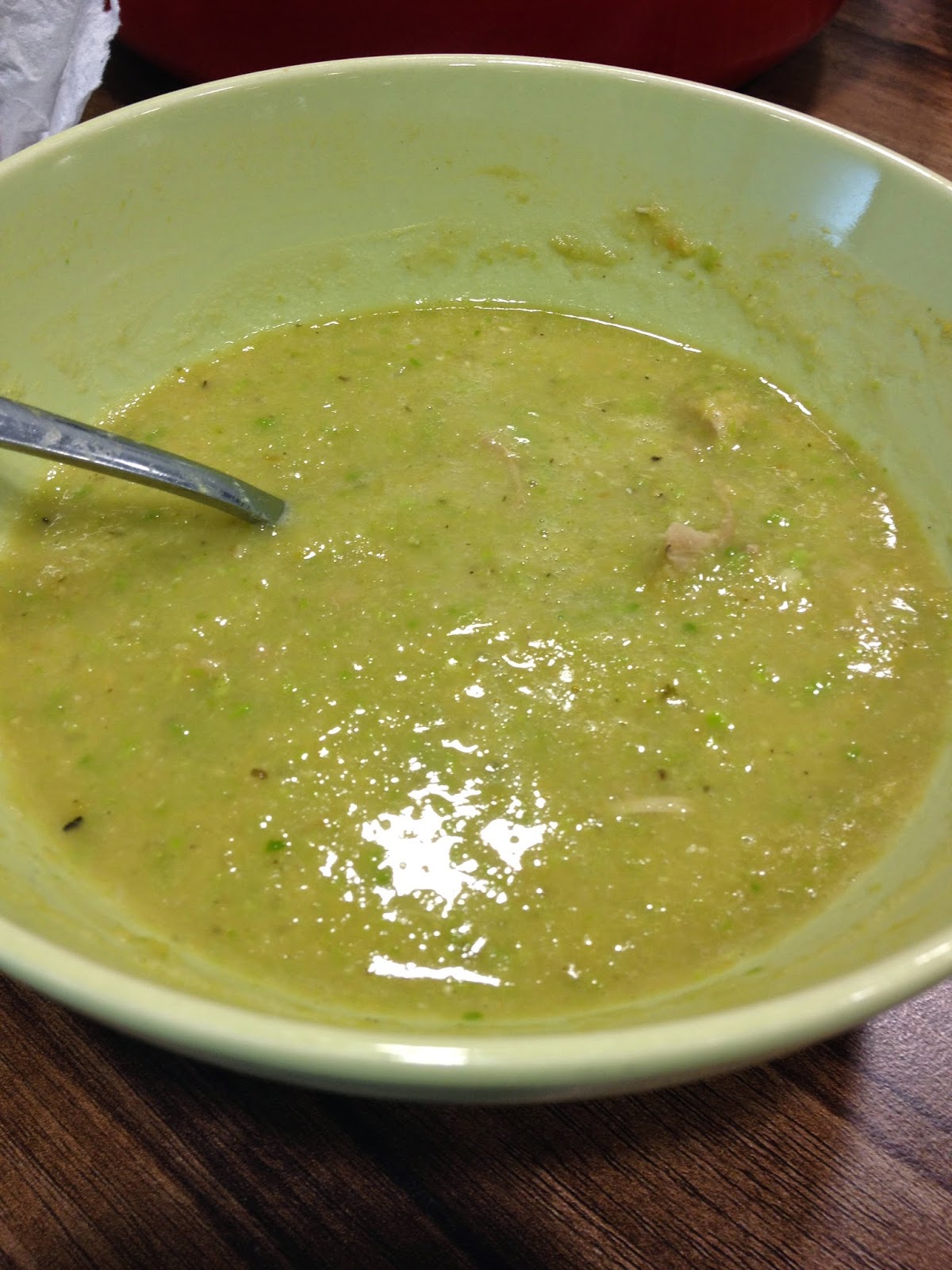
Pea and ham soup

Pea and ham soup in a green bowl
I thought soup weather was over but I was wrong - yesterday was rainy, windy and cold. Good thing I bought a ham hock at the weekend to make soup.

Ham hock sounds a lot posher than pork knuckle, but it's the same thing. In Poland it's called 'golonka', which is what we used to call my (half Polish) nephew when he was a baby.

I searched for soup recipes online and found ones that cooked vegetables with the ham hock for an hour, then pulled the meat off the hock to serve. Yuk! Vegetables that have been cooked for an hour!

Instead, I made a stock by cooking the veg and the ham then strained it. Amazingly, I got exactly 2 litres, so for once I can be accurate about the recipe quantities. However I forget to weigh the split peas before I soaked them, but it doesn't really matter how much you use -- it will just affect how thick you soup is. If it turns out too runny, add some red lentils to thicken, as they don't need to be pre-soaked, and only take about 15 minutes to cook. (The grated carrot will also thicken the soup slightly)

Ham hock stock 


  • 1 ham hock/pork knuckle
  • 2 small or 1 large carro
  • 2 medium onions
  • 2 sticks celery
  • 8 peppercorns
  • 1 bay leaf
  • 1 large sprig thyme (optional)

  1. Chop the vegetables roughly and add to a stock pot or large pan with the ham hock.
  2. Cover with cold water.
  3. Bring to the boil and simmer for about an hour.
  4. Leave everything in the pan till cool, then remove the ham hock and set to one side.
  5. Strain the liquor into a jug, and discard the soggy, overcooked vegetables.

Pea and ham soup ingredients


  • 2 medium onions
  • 2 sticks celery
  • 1 small carrot
  • Rapeseed or olive oil for frying
  • 2 litres ham hock stock
  • Meat pulled off 1 ham hock
  • 300g yellow split peas
  • 150g frozen peas

 How to make pea and ham soup

  1. Soak the split peas in a large bowl of cold water overnight.
  2. The next day, rinse well with cold water and leave to drain in a sieve over the bowl. 
  3. Heat a little rapeseed oil in a large pan.
  4. Finely chop 2 medium onions and 2 sticks celery.
  5. Fry onions and celery in the oil until soft.
  6. Grate the carrot and add to the pan.
  7. Pour in the stock.
  8. Add the split peas.
  9. Season with pepper and bring to the boil.
  10. Reduce to a simmer and continue cooking until the split peas are mushy.*
  11. Check the seasoning.
  12. Turn off the heat.
  13. Add the frozen peas - they will cook in the residual heat from the soup.
  14. Leave the soup to cool a little.
  15. Liquidise in batches.
  16. To serve, heat up only as much soup as you need, adding some of the ham pulled from the hock to warm through.
*The time taken for the split peas to become mushy will depend on how old they are -- if they have been sitting in the back of your cupboard for ages they could take a long time to go soft. 


Wednesday, 2 April 2014

Toasting seeds

Linseeds, it turns out, toast quicker than other seeds. Or, as some would have it, burn.

Thursday, 13 February 2014

A ploomin disaster Sunday lunch for friends

Plum harvest 2012, preserved with WD40

A Sunday lunch menu for friends


Moules mariniere with homemade bread
Beef and oxtail casserole
No plum crumble


Here's a post which has been 99% written for about a year and a half - I have no idea why I didn't finish and publish it sooner. Coincidentally I just wrote a beef and Guinness pie post last weekend. 

Last year (2013) I had a complete plum harvest failure, and had to beg, borrow and steal apples to make chutney. 

In 2012 I had a bumper plum harvest. 

I froze a hefty amount (almost 1.4kg) to make plum crumble for when I had friends round for Sunday lunch. 

I even made the crumble topping by combining flour, butter, demerara sugar and hazelnuts in the food processor, and froze that too. I hoped the sugar and hazelnuts would give a lovely crunch to the crumble. They may well do but I've yet to try it - it ended up festering in my freezer for a few months before being chucked out.

Plums, it turns out, do not freeze well. They turn to a pulpy mush that is 95% juice. 

We ended up skipping the crumble and moving straight onto the cheese. And another fail: I forgot to serve this with my plum chutney. D'oh.

Moules mariniere ingredients

  • 2 banana shallots 
  • A wineglass of dry white wine
  • A large knob butter
  • 2 bay leaves
  • 3 or 4 tablespoons flat leaf parsley, finely chopped
  • Splash of double cream  
  • Mussels. A lot. I asked my fishmonger for enough museels for 6 as a starter, then asked him to add more. The whole massive lot came to under a tenner. Wow! In a restaurant these would probably cost the same amount per portion. We had so many we couldn't even eat them all. 

How to make moules mariniere

Scrub the mussels clean in plenty of cold running water, discarding any that don't close when tapped sharply with the back of a knife. I guess this means they are still alive, but I'd rather not think too much about that. Remove the beards from any mussels that still have them by pulling them to the corner of the mussel then yanking vigorously.

You will need a very large pan to cook the mussels in - I use a stock pot. 


  1. Boil the wine rapidly for about 30 seconds to get rid of any harsh flavour, then remove from the pan. 
  2. Chop a couple of banana shallots very finely.
  3. Melt the butter in the pan then add the shallots and bay leaves.
  4. Stir to coat in the butter then add the wine and bring to the boil.
  5. Add the mussels then cover with a lid.
  6. Cook for a few minutes, shaking the pan vigorously about every minute, until the mussels open. 
  7. Add the cream and parsley and stir.
    Serve in a large bowl in the middle of the table, with another bowl for the discarded shells, and crusty bread.
  8. Do not eat any mussels that have not opened. 


Home-made white bread, perfect with mussels

White bread


I can't tell you how I made the bread in case I am asked to remove the recipe. I chose it because it was quick to make, and since it turned out very well its a shame I can't share it with you. 

Beef and oxtail casserole ingredients

  • Onions - 4 medium/large
  • Carrots - 4 large
  • Swede - 1 small
  • Celery - 2 sticks
  • Guniness - 2 bottles
  • Thyme - about 10 sprigs
  • Flour - about 3 tablespoons
  • Stewing steak - about 1.5kg, cut into chunks
  • Oxtail  - 8 pieces
  • Parsley, to serve*


*Personaly, I hate parsley. But some recipes, such as this one,  do taste better with a little sprinkling of the chopped herb. And for some recipes, such as moules mariniere (above), it is absolutely integral. Hence I had some to add to the casserole. 

Don't be tempted to put tinned tomatoes or tomato puree in this - I think it distracts from the flavour of the beef, whereas the Guinness enhances it. 

How to make beef and oxtail in Guinness

  1. Heat the oven to the Magic Cooking Number, 190 degrees C fan. 
  2. Heat a little rapeseed oil in a large casserole pan.
  3. Add the onions and fry gently for about 10 minutes, till they become translucent and very soft.  If you don't overdo it, this will give the onions a lovely caramelised taste. If you overdo  it will taste burnt. 
  4. Add the carrots, celery and swede.
  5. Fry for about 5 minutes, till the vegetables become slightly softened.
  6. Sprinkle the flour over the vegetables and stir to coat.
  7. Cook for about 3-5 minutes, stirring pretty much constantly.
  8. Turn up the heat and add the pieces of steak. 
  9. Brown the steak then add the oxtail pieces and brown too.
  10. Add the Guinness and bring to the boil.
  11. Cover with a lid and put in the oven for 2 hours.
 
I know this is going to cause controversy, but I served Yorkshire puddings with this casserole. Normally, my Yorkies rise well and are huge; for some reason this time they were a little flat. So another fail. 

Monday, 10 February 2014

Beef, Guiness and Stilton pie


My take on Jamie Oliver's no nonsense beef, Guinness and cheese pie. Substituting the cheddar for Stilton turns this pie into real man-food.


Beef, Guinness and Stilton pie ingredients


  • 800g stewing beef, cut into chunks
  • 500ml Guinness
  • 3 small onions
  • 3 cloves garlic
  • 4 sprigs rosemary
  • 2 medium carrots
  • 3 sticks celery
  • About 75g Stilton
  • 1 tablespoon plain flour
  • 4 portabello mushrooms
  • Homemade spelt rough puff pastry
  • A little egg


How to make beef, Guinness and Stilton pie


  1. Heat a tablespoon  of rapeseed oil in your largest Le Creuset casserole dish. If you don't have a selection of Le Creuset dishes, buy a large one to start with then ask for varying sized ones for birthdays and Christmas. The initial outlay may be expensive, but the rest of this recipe is pretty economical. 
  2. Heat the oven to the Magic Cooking Number 190 degrees C.
  3. Chop the onions roughly and fry gently for about 10 minutes.
  4. Chop the garlic finely.
  5. Roughly cut the celery and 1 of the carrots into large pieces. Grate the other carrot. 
  6. Pull the needles off the rosemary and chop finely. 
  7. If you're lucky enough to get your beef from an over-priced butcher with its own branded waxed paper, spread the beef out on the paper and sprinkle with 1 tablespoon plain flour then season generously with salt and black pepper. Pull up the 4 corners of the paper and give the whole lot a good shake to coat the beef with the seasoned flour. 
  8. If your beef comes from a normal butcher or (heaven forbid!) a supermarket, just put the meat, four, salt and pepper in a large bowl and toss together. 
  9. Add the garlic, carrots and celery then turn up the heat and add the floured beef and the rosemary.
  10. Fry for about 5 minutes till most of the meat is browned.
  11. Add the Guinness - if this doesn't completely cover the contents of the pan add some water so it does.
  12. Cover with the lid and bring to the boil.
  13. Put in the pre-heated oven for an hour and a half.

    My mum marinades the beef overnight in the Guinness when she makes this pie, but Jamie doesn't. As a compromise I got to this stage on Saturday evening and then switched the oven off, leaving the cooked beef in the Guinness overnight.
              
  14. The next day I cooked the beef for a further hour with the lid off to thicken the sauce, again at 190C.

    This actually reduced a little too much, but luckily I had a small pot of beef stock in the freezer which I added, ending up with the right amount of liquid.
  15. Remove from the oven and leave to cool while you make the pastry. You can of course use bough puff pastry if you prefer.
  16. Tip the beef into a pie dish and crumble the cheese into it.
  17. Roll out enough pastry to cover the top.

    I normally only cover the top of the pie with pastry, much to the disgust of Ollie, who says this is not a real pie. Today, because I'd made double quantity pastry, I did a top and bottom pastry pie, or, essentially, a giant pasty. However, I was right in my assumption that this would result in a soggy bottom - next time it will be top only.
  18. Drape the pastry over the pie dish and press down firmly around the lip of the dish. 
  19. Score the pastry with a knife in a criss-cross pattern. 
  20. Brush the pastry with a little beaten egg.
  21. Cook at 190C for about 45 minutes. 
Steak for pie
For some reason I forgot to take a picture of the actual pie, although I took one of the steak, raw and cooked:


Steak and Stilton before the pie bit was added


I do, however, appear to have a collection of photos of pies, so here's what it could have looked like: 

 
A pie (slightly blurred)

Monday, 3 February 2014

Pasta with mushrooms

This was a really tasty pasta dish. Since I'd already made the mushroom ragu it was ready in the time it took the pasta to cook (just under 10 minutes). 


Pasta with mushrooms and walnuts

Pasta with mushrooms ingredients


  • 2 rashers streaky bacon, chopped
  • 1 portion leftover mushroom ragu (which contains Stilton)
  • A v small handful walnuts
  • Sploosh red wine
  • a slice feta, crumbled
  • About 50ml cream, or as much as you have left over from something else
  • 4 cherry tomatoes
  • 50 ml milk if needed
  • Enough pasta for 2 people (I used conchiglie)

How to make pasta with mushrooms

  1. Boil the kettle then fill a large pan with boiling water.
  2. Add a large pinch of salt to the water, then add the pasta. 
  3. Heat a large frying pan on a high heat
  4. Add the chopped streaky bacon and fry until the fat begins to render and the bacon is crisp.
  5. Add the walnuts and fry for about a minute.
  6. Add the red wine and cook till most of the liquid has evaporated.
  7. Reduce the heat and add the mushroom ragu and tomatoes.
  8. Cook till the ragu has warmed through, the tomatoes have burst and the pasta is ready.
  9. Drain the pasta, reserving a small amount of the water, and blanch with freshly boiled water. 
  10. Add the cream and the reserved cooking water to the sauce. If it is still a little too tick, add the milk.
  11. Tip the pasta back into the pan and pour in the sauce.
  12. Add the crumbled feta and toss to coat the pasta with the sauce.
  13. Serve in warm bowls.

Friday, 31 January 2014

Keith Floyd's garlic chicken

My sister-in-law showed me this recipe when I last saw her on New Year's Eve. I have to admit I didn't pay that much attention to it at the time (I was watching Julie and Julia), so when O suggested I make it, it took a bit of online searching to find it. Eventually I came across it on this cycling forum:

http://www.cyclechat.net/threads/pot-roast-chicken-with-100-cloves-of-garlic.86254/

It is an incredibly blokey recipe, I admit. I could not Cope with the amount of Capital Letters used in the Recipe and had to Correct them in my version below, which also includes little more detail than the bike shop boys give. The cycling forum version also suggests that wind (or, as they call it, Wind) might be a consequence of eating this recipe. I don't think you are actually supposed to eat all the garlic that you cook - in fact I think we stopped at 1 or 2 cloves. 

The cycling forum also suggests the chicken is served with tagliatelle and a balsamic-dressed salad. I served this with rice, and forgot to take a photo. Unfortunately, I don't think there will be a next time. 


Ingredients for Keith Floyd's garlic chicken


  • 1 large chicken
  • 12 bulbs* garlic
  • 250 ml red wine vinegar
  • I bunch fresh thyme

*Yes, bulbs.

How to make Keith Floyd's garlic chicken


Heat the oven to 180 degrees C
Break up the garlic bulbs into unpeeled cloves, keeping 2 bulb's worth of cloves separate from the rest.
Place these 2 bulb's worth of garlic inside the cavity of the chicken along with the thyme.
Season the chicken with salt and pepper, then rub all over with olive oil.
Place the remaining garlic in a large casserole dish for which you have a lid.
Put the chicken on top of the garlic.

Pour in the red wine vinegar.
Cover the pot with the lid and place in the oven for 60-75 mins.

Take the lid off and cook for another 30 to 40 mins - if it looks like it is drying out, add a little water.
 

Tuesday, 28 January 2014

Soda bread

To go with the easiest soup in the world, here's the easiest bread in the world. It contains no yeast and so doesn't require proving and there's no kneading. Instead, bicarbonate of soda is used as the leavening agent, hence the name 'soda bread'.

I based my soda bread on the Delia Smith recipe which can be found in Delia's How to Cook Book 1. I haven't been able to find her recipe online so have outlined the differences between mine and Delia's versions here. My variations were based entirely on what ingredients I had in the kitchen. The resulting loaf made a pretty amazing accompaniment to leek and potato soup.


Soda bread* ingredients


*Delia calls hers Irish soda bread. 

  • 175g wholemeal flour (not wholemeal bread flour) plus extra for dusting
  • 50g plain flour
  • 50g medium oatmeal (Delia uses pinhead oatmeal)
  • 1 teaspoon bicarbonate of soda
  • 1.5 teaspoons salt
  • 1 teaspoon sugar
  • 1 large egg
  • 275ml buttermilk or yoghurt - Delia specifies buttermilk since but I only had about 50ml I topped it up to the full amount with yoghurt.

Delia includes 25g wheatgerm in her recipe. I don't. Apparently it's very good for you. 


How to make soda bread

  1. Butter a 450g loaf tin.
  2. Heat the oven to the Magic Cooking Number, 190C.
  3. Mix all the dry ingredients together in a large bowl.
  4. Add the egg to the buttermilk/yoghurt and beat together.
  5. Pour the liquid into the dry ingredients and mix together to form a stiff dough.
  6. Put the dough into the prepared tin and smooth the top.
  7. Sprinkle with a little additional flour.
  8. Bake for 50-60 minutes. 

Alternative soda bread recipe


Alternative soda bread

Following on from last weekend's experimental baking, I decided to have a go at another soda bread recipe. Again, the ingredients and quantities used were mainly based on what was in the cupboard, so I think a degree of flexibility is perfectly acceptable. 

Alternative soda bread ingredients

  • 50g medium oatmeal
  • 125ml water
  • 75g Greek yoghurt
  • 75ml milk
  • 1 teaspoon soft brown sugar
  • 175g wholemeal flour
  • 1 teaspoon fine salt
  • 1 teaspoon bicarbonate of soda
  • 15g butter

How to make alternative soda bread 

  1. Add the oatmeal to a large pan and cover with the water.
  2. Bring to the boil then turn off the heat.
  3. Cover with a lid and leave for 50 minutes.
  4. Beat the yoghurt, milk and sugar together and keep in the fridge till needed.
  5. After 50 minutes, add the butter to the oatmeal and beat until it disappears.
  6. Heat the oven to 190 degrees C (the Magic Cooking Number)
  7. Add the yoghurt mixture to the oatmeal and beat until smooth.
  8. Add the flour, bicarb and salt to the mixture and beat together to form a sticky dough.
  9. Butter and line a loaf tin.
  10. Tip the dough into the tin and cover the top, either with silicome paper if using, or tin foil.
  11. Bake for 15 minutes.
  12. Remove the foil/silicone and bake for another 30 minutes.